

When you hold a smartphone, fly on a jet, or undergo a medical procedure using high-tech devices, you rarely stop to consider the invisible forces that make it all possible. But behind these marvels lies a precise, deliberate process—precision metal fabrication—that silently powers innovation in the world’s most advanced industries.
Table of Contents
- When Precision Meets Purpose
- What Makes Metal Fabrication “Precise”?
- Precision Metal Fabrication in the Electronics Industry
- Precision Metal Fabrication in the Medical Equipment Industry
- Practical Applications and Successful Projects by Morshedi
- Emerging Trends in Precision Metal Fabrication (2024 and Beyond)
- Table 2: Comparison of Emerging Technologies in Metal Fabrication
- Conclusion: Driving Precision and Innovation Forward
- Take the Next Step with Morshedi
In the realm of high-tech manufacturing, even a millimeter of error can lead to catastrophic consequences. That’s why companies across aerospace, electronics, medical devices, and energy sectors rely on the unwavering accuracy and consistency of metal fabrication. And in the GCC region, Morshedi Building Metal Products Manufacturing LLC has emerged as a trusted name delivering those exacting standards.
Founded on over 20 years of extensive experience, Morshedi isn’t just a fabricator—it’s a partner in innovation. As high-tech industries continue to push the boundaries of what’s possible, precision metal fabrication is no longer optional; it’s essential.
Let’s explore how this often-overlooked craft quietly shapes the future—one flawless cut at a time.
When Precision Meets Purpose
While precision metal fabrication is the lifeblood of high-tech industries, its value multiplies when applied to specialized projects—those that defy one-size-fits-all solutions and demand tailored engineering. If you’ve ever wondered how custom metal solutions elevate niche applications, we recommend diving into our detailed article on this very topic:
Why Custom Metal Fabrication Is Essential for Specialized Projects
From aerospace to experimental medical tech, precision isn’t just a buzzword—it’s a business-critical necessity.
Image caption: A state-of-the-art CNC laser cutting system in action, demonstrating the precision of modern metal fabrication.
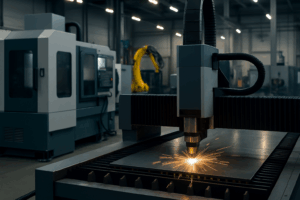 A state-of-the-art CNC laser cutting system in action, demonstrating the precision of modern metal fabrication.
What Makes Metal Fabrication “Precise”?
Precision metal fabrication isn’t just about working with metal—it’s about working with metal at the microscopic level of tolerance. In high-tech industries, a single micron off-spec can result in product failure, safety issues, or massive financial loss. That’s why precision isn’t a luxury—it’s a critical requirement.
Here’s what makes metal fabrication truly precise:
1. State-of-the-Art Machinery
Technology lies at the heart of precision. CNC machines, fiber laser cutters, and robotic arms enable fabricators to achieve tight tolerances (±0.005 mm or less). This level of detail ensures parts fit seamlessly into complex assemblies like circuit boards, aerospace components, and medical devices.
“Precision is achieved not by accident, but by automation, calibration, and consistency.” — Manufacturing Today Journal
2. Certified Materials
You can’t build precision with poor raw materials. High-grade metals like 304/316 stainless steel, aluminum alloys, and titanium are essential in industries where strength and weight must be perfectly balanced. Each material comes with traceability certificates and complies with international standards (ISO, ASTM, etc.).
3. Skilled Engineering and Inspection
Machines execute the work, but human expertise designs, oversees, and inspects it. Engineers use CAD/CAM software for ultra-precise designs, and QA teams employ coordinate measuring machines (CMMs), digital calipers, and laser scanners to inspect dimensions at the micro level.
4. Controlled Environments
Precision requires consistency. That’s why high-end fabrication shops like Morshedi maintain temperature-controlled workshops to minimize metal expansion or contraction during cutting and welding. Even a few degrees of change can throw off measurements.
5. Process Documentation and Standardization
Every fabrication step is documented and standardized—from cutting and forming to welding and finishing. This ensures repeatability, which is essential for mass production in sectors like aerospace or electronics, where thousands of identical units are required.
Precision Metal Fabrication in the Electronics Industry
Precision metal fabrication plays a crucial role in the electronics industry, where the demand for miniaturization and reliability is higher than ever. Components must be manufactured with extreme accuracy to ensure proper functionality, heat dissipation, and longevity.
Key Aspects:
Miniaturization and Complex Designs
With devices shrinking—from smartphones to wearable tech—the metal parts involved must be fabricated with tolerances often below ±0.002 mm. This demands advanced CNC machining and laser cutting technologies.
Material Selection
Electronics fabrication commonly uses copper, aluminum, and stainless steel for their conductivity, corrosion resistance, and durability. Specialized coatings may also be applied to improve performance.
Thermal Management
Efficient heat dissipation is critical. Precision fabrication ensures components like heat sinks and enclosures are optimized to manage thermal loads effectively.
Integration with Other Processes
Metal fabrication must seamlessly integrate with PCB assembly, plastic molding, and surface treatments, requiring collaboration across multiple manufacturing domains.
| Metal | Key Properties | Typical Applications |
|---|---|---|
| Copper | Excellent conductivity | Connectors, heat sinks |
| Aluminum | Lightweight, corrosion-resistant | Casings, heat spreaders |
| Stainless Steel | Strong, corrosion-resistant | Structural supports, shielding |
 Precision metal fabrication transforms raw materials into high-tech components with microscopic accuracy.
Precision Metal Fabrication in the Medical Equipment Industry
Precision metal fabrication is a cornerstone of the medical equipment industry, where accuracy, biocompatibility, and durability are non-negotiable. From surgical tools to implantable devices, every component must meet strict standards to ensure patient safety and device performance.
Key Elements:
Biocompatible Materials
Materials like titanium, stainless steel, and cobalt-chromium alloys are favored for their biocompatibility, corrosion resistance, and mechanical strength.
Tight Tolerances for Safety
Medical devices often require tolerances as tight as ±0.001 mm to guarantee proper fit and function, especially in implants and surgical instruments.
Regulatory Compliance
Fabricators must follow strict regulations such as ISO 13485 and FDA standards, ensuring traceability, quality control, and documentation.
Advanced Manufacturing Techniques
Techniques like CNC machining, EDM (Electrical Discharge Machining), and laser cutting are essential for producing complex, high-precision parts.
| Metal | Properties | Typical Applications |
|---|---|---|
| Titanium | Lightweight, strong, biocompatible | Implants, surgical tools |
| Stainless Steel 316L | Corrosion resistant, durable | Surgical instruments, implants |
| Cobalt-Chromium Alloy | High strength, wear resistant | Orthopedic implants |
Practical Applications and Successful Projects by Morshedi
Morshedi Building Metal Products Manufacturing LLC has established itself as a leader in the metal fabrication industry, delivering high-quality solutions across various sectors. Here are some notable projects and applications that highlight their expertise:
1. Architectural Metalworks for Construction Projects
Laser-cut facades and decorative panels: Enhancing building aesthetics with intricate designs.
Structural supports and frames: Ensuring durability and safety in construction.
2. Customized Furniture Components
Laser-cut metal parts for tables and chairs: Combining functionality with artistic design.
Metal bases for lighting fixtures: Adding a modern touch to lighting solutions.
3. Automotive Industry Parts
Lightweight metal components: Contributing to fuel efficiency and performance.
Durable parts for vehicle interiors: Ensuring longevity and safety.
4. Retail Display Units
Custom metal display stands: Tailored to enhance product visibility and appeal.
Modular shelving units: Offering flexibility and functionality in retail spaces.
Table 1: Industries Served by Morshedi
| Industry | Applications |
|---|---|
| Construction | Facades, structural supports |
| Interior Design | Furniture components, lighting fixtures |
| Automotive | Lightweight components, interior parts |
| Retail | Display units, shelving systems |
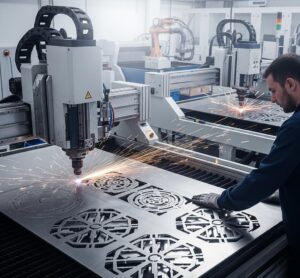 The art and science of precision metal fabrication in action, where human expertise meets advanced machinery to create flawless components.
Emerging Trends in Precision Metal Fabrication (2024 and Beyond)
The landscape of precision metal fabrication is undergoing significant transformation, driven by advancements in technology and evolving industry demands. Staying abreast of these trends is crucial for companies like Morshedi to maintain a competitive edge and continue delivering high-quality solutions. Below are some of the most impactful trends shaping the industry:
1. Advanced CNC and Fiber Laser Technologies
Among the most notable advancements is the increased precision of CNC machines and modern fiber laser systems. These tools can cut and shape metals with tolerances as tight as ±0.005 mm, critical for sectors like aerospace, medical devices, and microelectronics. According to C.E. Smith Company, technologies like the TruLaser Tube 5000 are revolutionizing the industry by enhancing flexibility, automation, and overall efficiency—reducing cost while improving output quality.
These advancements enhance efficiency and expand the capabilities of metal fabrication.
2. Integration of 3D Metal Printing
Technologies like Electron-Beam Freeform Fabrication (EBF³) and Selective Laser Melting (SLM) enable complex, customized metal parts with minimal waste.
3. Automation and Robotics
Robotics enhance precision, productivity, and safety by performing repetitive or hazardous tasks with consistent accuracy.
4. Internet of Things (IoT) and Industry 4.0
Real-time monitoring, predictive maintenance, and smart production optimize manufacturing efficiency and reduce waste.
5. Sustainable Practices
Energy-efficient processes, material recycling, and eco-friendly materials are increasingly prioritized to reduce environmental impact.
Table 2: Comparison of Emerging Technologies in Metal Fabrication
| Technology | Benefits | Applications |
|---|---|---|
| High-Power Fiber Lasers | Faster cutting speeds, precision | Aerospace, automotive, construction |
| Hybrid Laser Systems | Simultaneous cutting, welding, additive manufacturing | Complex assemblies |
| Electron-Beam Freeform Fabrication | Minimal material waste, complex geometries | Aerospace, medical devices |
| Selective Laser Melting | Intricate designs, rapid prototyping | Aerospace, medical, automotive |
| Robotics and Automation | Consistent quality, increased productivity | Repetitive tasks, hazardous operations |
| IoT and Industry 4.0 | Real-time data, predictive maintenance | Smart factories, supply chain optimization |
| Sustainable Practices | Reduced environmental impact, cost savings | All sectors |
Conclusion: Driving Precision and Innovation Forward
In a world increasingly defined by technological breakthroughs, precision metal fabrication stands as a fundamental enabler—turning visionary concepts into reliable, tangible realities. Through cutting-edge machinery, skilled craftsmanship, and rigorous quality standards, Morshedi Building Metal Products Manufacturing LLC continues to shape the future, one precisely crafted piece at a time.
Take the Next Step with Morshedi
Ready to elevate your projects with expert metal fabrication services? Learn more about our commitment and capabilities by visiting our About Us page.
Have questions or want to discuss your specific needs? Our team is here to help—reach out anytime via our Contact Us page.
Discover our full range of services and download our latest product catalog to see how Morshedi can support your business goals.
Your precision metal fabrication partner awaits—connect with us today!.